We Now shipping across QC, ON, NS & NB!
Free online maintenance courses. Learn more
Chemicals: Save up to 10% when you buy 3+ identical items. Learn more
INNOVA Loyalty Program: create your account, earn points and enjoy exclusive benefits! Learn more
Free shipping on $50+ for chemicals and small accessories.
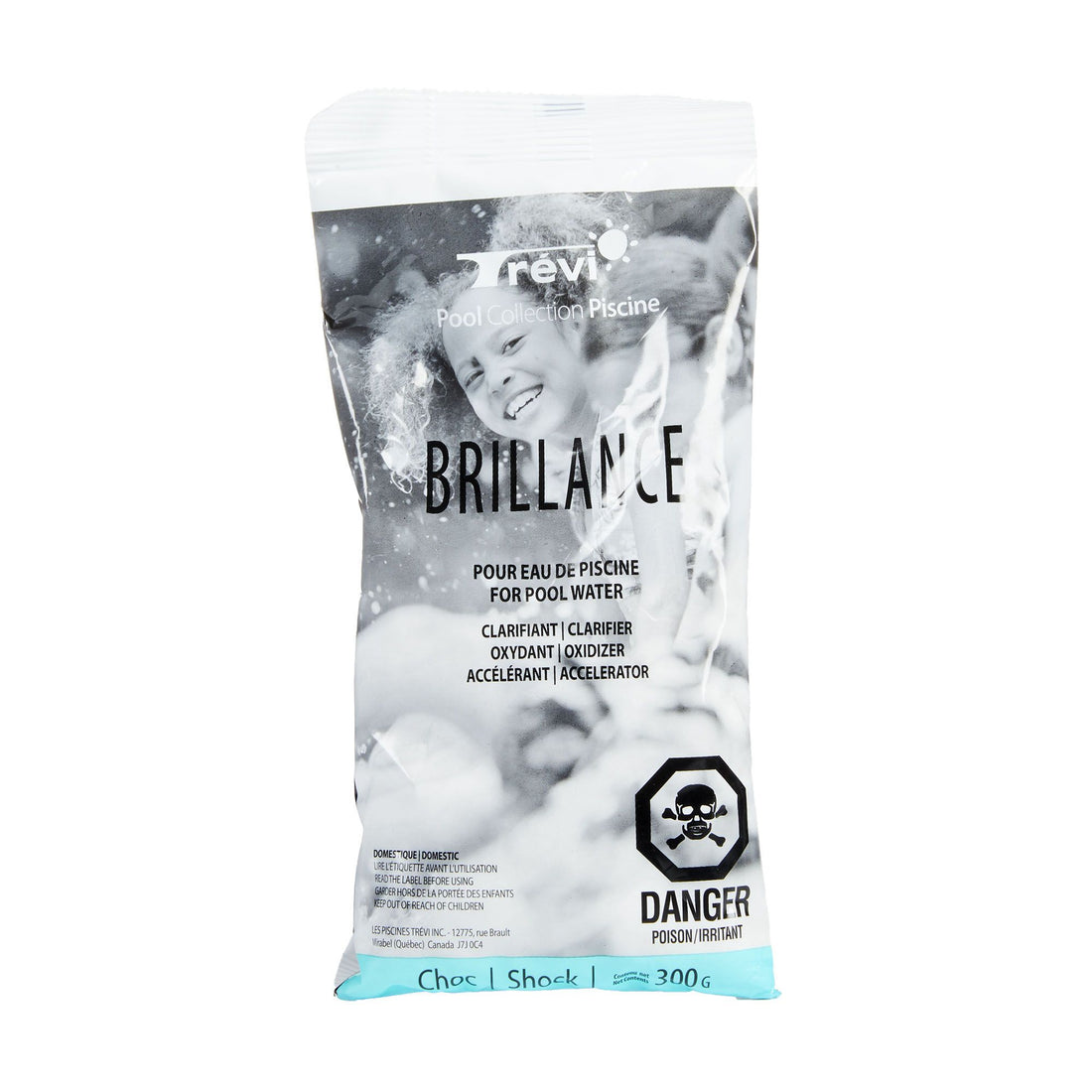
This weekly shock treatment quickly eliminates organic contaminants from pool water while improving its clarity. Its formula combining an oxidizer and a clarifier restores water clarity and prolongs chlorine's effectiveness.
Read more
Read less
SKU: 35673
Availability
In-store pickup
Pickup available in 24 hours at 04 Laval
Pickup unavailable at 04 Laval
In-store availability
209
In stock at
04 Laval
209
In stock at
04 Laval
Sold out at
04 Laval
This weekly shock treatment helps quickly eliminate organic contaminants in pool water while improving its clarity. Its formula, combining an oxidizer and clarifier, restores water clarity and extends chlorine effectiveness.
Features
Shock treatment combining an oxidizer and clarifier
Eliminates organic waste present in the water
Helps maintain clear and sparkling water
Controls algae formation
Compatible with chlorine and saltwater pools
Convenient pre-measured sachet format
Type: Pool shock treatment
Function: Oxidizer, clarifier, and water cleaning accelerator
Format: 300g or 600g sachet
Treatment capacity: Up to 45,000 liters of water per sachet
Application: Add directly to the water surface while the filtration system is running
Main Actions:
Shock treatment
Product Category:
Shock Treatments
Dissolution:
Fast
Dosage:
150 g / 10000 L
Forms:
Granules
Application Method:
To pour directly into the water
Safety and Storage:
Add granules to water, never the reverse,
Follow the manufacturer's instructions,
Store away from cold,
Store away from heat,
Avoid contact with skin,
Use appropriate protective equipment,
Keep out of reach of children and animals
Treatment Time:
30 min
Basin Type:
Pool
Precautions and first aid
DANGER â POISON â CORROSIVE. Contents may be harmful and cause burns. Fumes and dust may be harmful and become hazardous when mixed with other products. Do not breathe dust or fumes. Do not swallow. Avoid contact with eyes, skin, or clothing. Do not mix with other chemicals. Use only in a well-ventilated area. Keep out of reach of children. Read label before use. Use all of the contents after opening. This container is not child-resistant.
In case of contact with skin or eyes, rinse thoroughly with water for several minutes. In case of ingestion or significant exposure, seek immediate medical attention.
Shipping is free for this product on orders of $50 or more in Quebec and Ontario. A $10 shipping fee applies to orders under $50.
For New Brunswick, a $40 shipping fee applies regardless of the order amount.
For Nova Scotia, a $50 shipping fee applies regardless of the order amount.
Use one 300 g sachet per treatment for a swimming pool up to 45,000 litres of water. Sprinkle the product all around the pool directly on the water surface when the filtration system is running.
Use one 600 g sachet per treatment for a swimming pool up to 90,000 litres of water. Sprinkle the product all around the pool directly on the water surface when the filtration system is running.
Use once a week to maintain clear water and help eliminate organic residue. Wait approximately 20 minutes before swimming after application.
Key Features
Elimination
Product designed to effectively destroy algae and ensure healthy and safe water.
3-in-1 action
Eliminates contaminants, improves water clarity and accelerates the action of treatments.
Treatment time
Allows you to bathe approximately 15-20 minutes after application
Simple to use
Pre-measured sachets for easy use
When, why and how to perform shock treatment in a swimming pool?
Shock treatment is used to clean pool water by removing chloramines (the harmful chlorine responsible for odors and irritations) while helping to keep the water clear. It generally contains stabilized chlorine, an oxidant, and a clarifying agent.
Generally, it's used once a week, or more often during heat waves, heavy swimming, or if the chlorine level is low. The video shows two examples: Smart Shock and Shine, which are added directly to the water for fast action.
This weekly shock treatment quickly eliminates organic contaminants from pool water while improving its clarity. Its formula combining an oxidizer and a clarifier restores water clarity and prolongs chlorine's effectiveness.
Read more
Read less
Powerful shock treatment â ââQuickly eliminates organic contaminants in water to restore clean and safe water.
Fast acting â Oxidizing formula that works quickly to clean water and improve chlorine effectiveness.
Improves water clarity â Contains a clarifier that helps restore clear, sparkling water.
Easy-to-use format â Pre-measured 300g sachet to be poured directly into the pool while the filtration system is running.
Multipurpose treatment â ââHelps control algae growth and is compatible with chlorine and salt water pools.
Additional details
Treatment capacity: up to 45,000 liters of water per sachet.
Simple application: add directly to the surface of the water with the filtration running.
This 3-in-1 shock treatment quickly restores the water quality of your pool. Its formula acts as a disinfectant, clarifier, and accelerator to achieve clear, clean water in a single treatment.
Read more
Read less
High-performance 3-in-1 shock treatment â ââQuickly disinfects pool water by eliminating bacteria, algae and contaminants to restore clean and safe water.
Fast and effective action â Formula designed to act quickly and restore water balance after heavy use or cloudy water.
Clarifies water â Contains clarifying agents that help restore clear and crystalline water.
Very practical format â Easy-to-use 400g pre-measured sachets for precise and error-free dosing.
Multipurpose treatment â ââCombines disinfection, clarification and treatment acceleration for simple and effective maintenance.
Additional details
Format: box of 4 sachets of 400g
Application: Pour the contents of the sachet directly into the pool for fast action.
Impact+ is a shock treatment in pre-measured sachets designed to simplify your pool maintenance while ensuring maximum effectiveness. Its formula works quickly to eliminate contaminants and help maintain clear, well-disinfected water.
Read more
Read less
Powerful shock treatment â ââQuickly eliminates organic contaminants, bacteria and algae to restore clean and safe pool water.
Fast acting â Formula designed to act quickly and improve water quality after cloudy water or heavy pool use.
Helps restore water clarity â Helps restore clear and well-disinfected water.
Very practical format â Resealable pre-measured 400g bags allowing for precise dosing and safer handling. Pre-mix before adding to the water
Multipurpose treatment â ââSuitable for regular maintenance or for shock treatment when required.
Additional details
Format: 10 kg (25 sachets of 400 g)
Packaging: individual resealable bags to limit direct contact with the product.
Pool shock treatment is a versatile product used for both regular maintenance and to correct certain water problems. It helps eliminate contaminants, clarify water, and quickly increase chlorine or bromine levels to maintain clean, well-disinfected water.
Shock treatment can be used in several situations:
Regular maintenance: helps eliminate contaminants and maintain clean water
Visual problems: clarifies cloudy water and helps correct early-stage algae
Learn how to master the essential steps to maintain your pool throughout the summer and enjoy clean, healthy water. To go further, check out our complete pool maintenance guide or sign up for our online courses to simplify your routine and adopt best practices.
It is now time to choose the sanitizing system you wish to use to treat your pool water. Many options are available.Â
Owners of salt chlorination systems must remember to turn on the system cell only when the water reaches +/- 65°F to ensure that the cell generates enough chlorine to properly treat the water. If pool water has not reached this temperature, you can use granulated chlorine as indicated on the container.Â
For owners of ozone generators and chlorinators, temperature restrictions do not apply. You can use these systems when starting the pool.Â
Finally, know that there is another simple and efficient way to treat your pool water â use our maintenance kits available in stores.
Chose the option that suits you best to enjoy your pool all summer long!
Throughout the summer, it is your responsibility to test your water once a week with the help of strips or droplets. These tests will help keep your water clean, safe and enjoyable to swim in.Â
It is also very important to visit the store with a water sample once a month to have your water tested at the test counter for a complete analysis and to balance it properly. You will need to take a water sample that has been collected from your pool in a sterile bottle no more than 2 to 3 hours before the test.Â
To analyze the water, we will need to know the volume of water in your pool or the size of the pool and your sanitation system, either salt or chlorine. We will then be able to give you the appropriate recipe to make the water safe for the pool, the equipment and the swimmers.
This will yield important information, starting with your chlorine level. This should be kept between 1 and 3 ppm, or 1 if you have an ozonator. If you are having trouble keeping your chlorine level stable, it may be due to the pH, which should be between 7.4 and 7.6. A pH that is too high or too low will affect the chlorine. For example, the chlorine may evaporate too quickly if the pH is too low, or it may not work at its full capacity if the pH is too high. Be aware that the pH of your eyes is 7.5, which is one of the reasons why the pH of your water should be between 7.4 and 7.6. This will prevent your eyes from hurting upon contact with the water.
If you are having trouble with your pH, it may be because the alkalinity is out of balance. At the water analysis counter, our advisors can help you balance this parameter and inform you about the level of calcium in your pool. This is another important aspect of preserving your equipment for as long as possible, since it has an impact on corrosion, among other things.
Follow the steps of the recommended recipe, since you have waiting times between each addition and must respect a specific order when adding products to your pool. You should also refer to the labels on the products, as each product can be added to the water in a different way, either diluted or directly in the pool. Your water will then be clean and pleasant to swim in.
Storms can affect the chemical parameters of your pool water, notably chlorine and pH. Itâs important to test your water with strips or droplets after heavy rain to check and adjust the chlorine and pH levels.Â
Rain water brings more contaminants so you must provide more chlorine to the water with a pouch of Brillance or Smartchoc.Â
Also, rain is acidic, so it tends to lower the pH level. To increase the pH, we recommend that you test your water in-store to ensure that alkalinity and calcium are well adjusted.Â
Itâs also critical to check the dry well if you have an in-ground pool to ensure that the water level isnât too high. Go to our website, to watch our video tutorial on this topic to avoid that bubbles and pleats appear on your pool liner.Â
And, no matter if you have an above-ground, in-ground, or built-in pool, you must prevent the water level from raising above 3/4 of the skimmer to ensure an optimal filtration. If this were the case, drain some water to reach the right level.Â
Now, go enjoy the nice weather and take a swim before the next storm!Â
If the pool remains green after a shock treatment, it's often due to one of the following situations: the shock treatment wasn't strong enough for the amount of algae present, the pH was too high (making chlorine almost ineffective), the filter is saturated and can no longer trap particles, or there are high phosphate levels that feed the algae. In this case, you should: adjust the pH, perform a stronger shock treatment, thoroughly brush the pool, and clean the filter. Sometimes, a clarifier or phosphate remover treatment is necessary to complete the cleaning.
Dissolve the shock chlorine in a bucket of water before adding it to the pool to avoid damaging the liner or coating. Pour the solution all around the pool, keeping the pump running. If you are using a chlorine-free (oxidizing) shock treatment, add it directly to the water according to the manufacturer's instructions. Avoid shock treatment in direct sunlight to prevent loss of effectiveness.
After shocking the system, let the filtration run continuously until the water becomes clear. Brush the walls and bottom to loosen any algae, then clean or rinse the filter, as it accumulates a lot of debris during this process. Next, test the chlorine and pH levels to rebalance the water if necessary. Proper filter maintenance is essential for quick and lasting results.
Shock treatment usually takes effect within a few hours, but you should expect12 to 24 hoursto restore the water to its original clear state. If the water was very green or cloudy, this can take up to48 to 72 hourswith continuous filtration. Always wait until the chlorine level drops below5 ppmbefore swimming.
To perform a shock treatment, first check that the pH is between 7.2 and 7.6 for the product to be fully effective. Then dissolve the recommended amount of shock chlorine in a bucket of water and pour the solution around the perimeter of the pool with the pump running. If the product is in sachets, pour the sachet directly around the perimeter of the pool. Let the filter run continuously to ensure the product is well dispersed. Shock treatment eliminates algae, oxidants, chloramines, and organic contaminants that accumulate in the water.
A pool shock treatment should be performed approximately once every 1 to 2 weeks during the swimming season. It is also recommended to perform it after a storm, heavy pool use, or if the water turns green or cloudy. Proper pH balance before treatment ensures maximum effectiveness.
Overall rating: 4.888889 / 5 from 9 reviews.
AI Generated Review Summary
Summary topics
Review topics: [].
Review highlights
Reviews
Notre piscine est super clair
"Notre piscine est super clair et on a mit juste 2 traitements chocs en un peu plus qu’un mois et demi."
— DAVID L. (5/5)
Bon
"Ça très bien fonctionner merci"
— RICHARD L. (5/5)
.
"Très satisfaite de ce produit."
— Lucie E. (5/5)
Excellent
"Excellent"
— GIANNI L. (5/5)
Efficacité
"Bon résultat"
— F M. (5/5)
Brillance Shock
"Excellent product"
— Jean B. (5/5)
Good
"Good"
— CHARLINE B. (5/5)
bien
"bien"
— PIERRE B. (4/5)
Good
"Good"
— MAAN F. (5/5)
Q&A
>
Recommended products
Choosing a selection results in a full page refresh.