
Before diving into the swimming season, make sure your pool is fully ready for clean, safe, and enjoyable water. This pre-season inspection guide walks you through every essential step—from checking your equipment to balancing your water chemistry and preventing unexpected issues. Get your pool off to the perfect start with this complete checklist.
|
Reading time : 1 minute
Complete Pre-Season Pool Inspection Guide

Now is the perfect time to inspect your pool
Before diving into the summer season, take a few minutes to check the condition of your pool and equipment. An inspection at the start of the season helps you quickly identify any breaks or malfunctions so you can repair or replace what’s needed, thereby avoiding unpleasant surprises. To help you, print out our handy opening checklist and bring it with you to the pool—it’s designed to let you easily take notes during your inspection.

Check the condition of the liner
The best time to inspect your foundation is in the spring, as soon as the ice has melted away from the walls. Look for these critical signs:
- Discoloration or cracks: These indicate a liner that has been weakened by age.
- Buckling: Often caused by water seeping under the liner.
- Groundwater: For in-ground pools, empty your sump pit if the liner is lifting.
If replacement is necessary, it’s best to do so before opening your pool.
💡 TIP
Did you know that poorly balanced water can quickly discolour your liner and directly affect its quality?
Need to replace the liner?
Check the accuracy of the pressure gauge
It is recommended that you replace it every year at the start of the season to ensure accurate readings.
- Establish the natural pressure: Take a reading when your filter is completely clean (sand washed or new cartridge).
- When to clean: If the pressure rises 5 to 10 PSI above the natural pressure, cleaning (backwashing or cartridge flushing) is necessary.
- Installation: Always use Teflon tape on the threads of the new pressure gauge to ensure a perfect seal.
💡 TIP
The pressure gauge should return to zero when the pump is turned off.
Replace the pressure gauge
Check the condition of the skimmer basket
Make sure the basket is in perfect condition to protect your pump:
- Cracks: Inspect the plastic for cracks caused by winter freezing.
- Integrity: Replace it if it is broken, as a damaged basket allows debris to enter the pump.
- Positioning: Make sure it fits snugly into its housing for optimal filtration right from the start.
💡 TIP
Did you know there’s a net designed to catch small debris?
Check the condition of the pump basket
Before starting the system, inspect the strainer basket to protect your system’s motor:
- Cracks: Replace the strainer basket if it has cracked due to winter freezing.
- Protection: An intact strainer basket is crucial to prevent debris from blocking the pump impeller.
- Lid gasket: Check that the gasket is flexible and properly seated to prevent air leaks.
💡 TIP
Don't forget to close your valves to avoid getting wet and to make priming easier.
Need parts?
Check the state of the cartridge
Inspect your cartridges at the start of the season to ensure clear water all summer long:
- Signs of end of life: If the filter media remains clogged after washing or if it is frayed, filtration will no longer be effective.
- Replacement: Plan to replace them after 3 to 5 years of use, depending on how well they have been maintained.
- Initial use: Use your old cartridges for the first spring cleaning to avoid unnecessarily soiling the new ones.
💡 TIP
The average lifespan is 3 to 5 years.
Replace the cartridge
Check the condition of the sidewalk or pavement
Inspect the perimeter for frost damage:
- Safety: Look for any lifting or sinking that could pose a tripping hazard.
- Cracks: Identify any cracks to prevent water from seeping under the pool.
- Joints: Check the seal between the sidewalk and the coping.
- Stability: Make sure the polymer sand is still in place.
💡 TIP
It is important to check the condition of your polymer sand joints.
Check the condition of the pump
Perform these visual inspections before starting the pump to prevent motor burnout:
- Cracks: Inspect the pump housing for damage caused by winter freezing.
- Rotation: Make sure the motor shaft is not seized and turns freely.
- Sealing: Check that the connections are intact and that the rear fan is unobstructed.
- Noise: When starting, listen for any abnormal whistling, which may indicate worn ball bearings.
💡 TIP
Did you know that Trévi offers in-store inspections and repairs?
Replace the pump
Check for water stains on the liner
💡 TIP
Remove water stains as soon as possible to prevent them from setting in.
The Best Cleaning Products
Check the condition of your leaf blower, leaf rake, and telescopic handle
Vaccum hose
💡 TIP
Don't forget that the rotating hose nozzle must be attached to the sweeper's head.
Vacuum head
💡 TIP
Make sure the bristles on the sweeper are in good condition to avoid damaging your canvas.
Vacuum blade
💡 TIP
It is essential to prevent large debris from clogging your pipes.
Telescopic handle
💡 TIP
Be careful around power lines.
Leaf skimmer
💡 TIP
Make sure it isn't cracked so you don't end up wasting your time.
Replace obsolete parts
Heat Pump Cleaning
💡 TIP
It is important to clean the grille around your heat pump thoroughly on a regular basis to ensure optimal performance, especially during pollen season.


Water test strip
Test strips are essential for proper water management:
- Accuracy: Expired reagents skew readings, leading to costly dosing errors.
- Maintenance: A proper chemical balance protects the filter media from drying out and prevents motor corrosion.
- Safety: They ensure effective disinfection against bacteria and algae.
💡 TIP
Make sure your test strips haven't expired.
Stock up on water test strips for the season
Chemical Inventory
Take stock of your supplies to plan your purchases without wasting anything:
- Inventory: List your remaining supplies (chlorine, salt, shock treatment) and make sure they are completely dry.
- Calculator: Use our chemical calculator to get a precise dosage based on your water volume.
- Estimate: Give us your pool’s dimensions and the length of your swimming season; we’ll calculate the exact amounts you’ll need for the year.
💡 TIP
Did you know that chemicals lose their effectiveness when they freeze and thaw?


Loading quiz...

Pool opening guide
Saviez-vous que les produits chimiques perdent leur efficacité lorsqu'ils gèlent puis dégèlent ?
ONLINE CLASSES
Pool Opening
Join our pool opening webinar and learn the essential steps for getting your pool up and running efficiently, restoring clear water quickly, and starting the season off on the right foot.


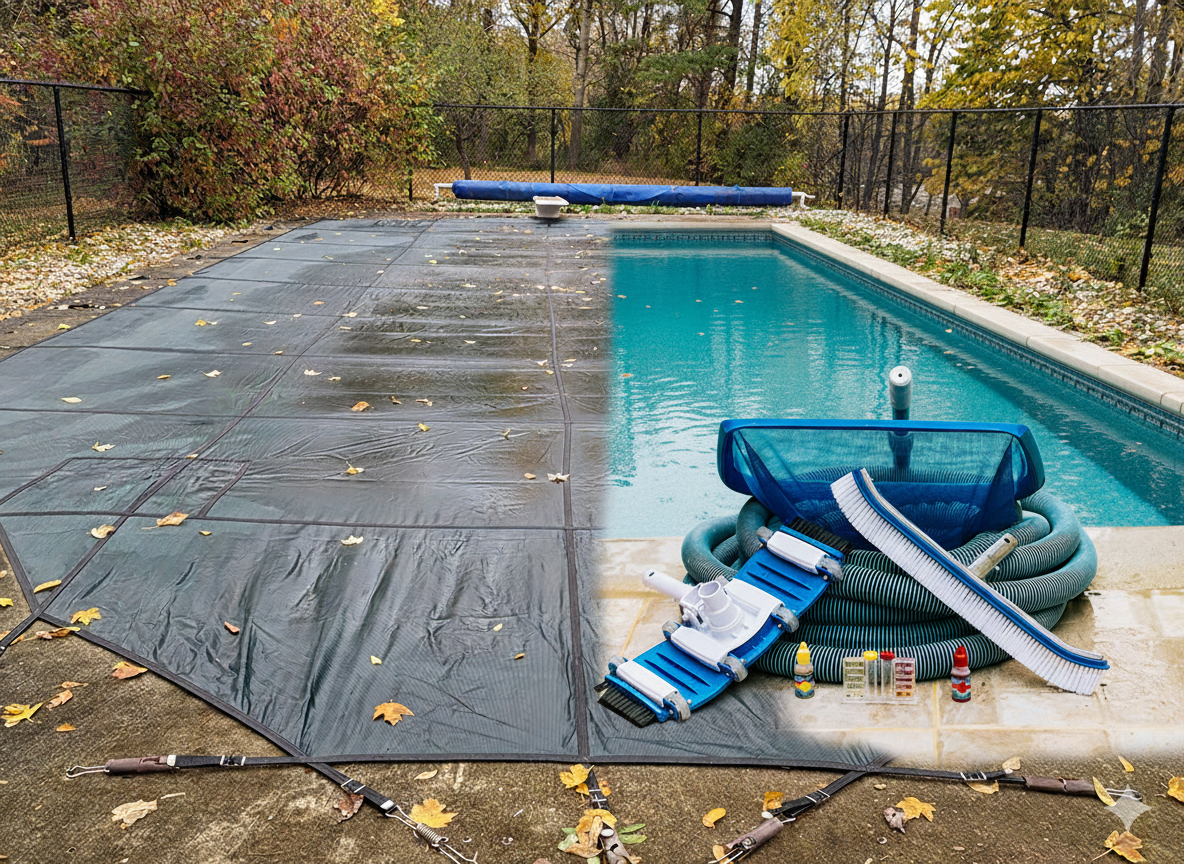

Pool Opening Service
Don't want to stress about it? Schedule your pool opening with one of our experts this spring.
Book early to make the most of the season!


Everything for your pool and spa maintenance, online.
Get free access to our courses, practical guides, and online water analysis tool to keep your water clear and healthy all summer long.